
⚡ Quick Answer
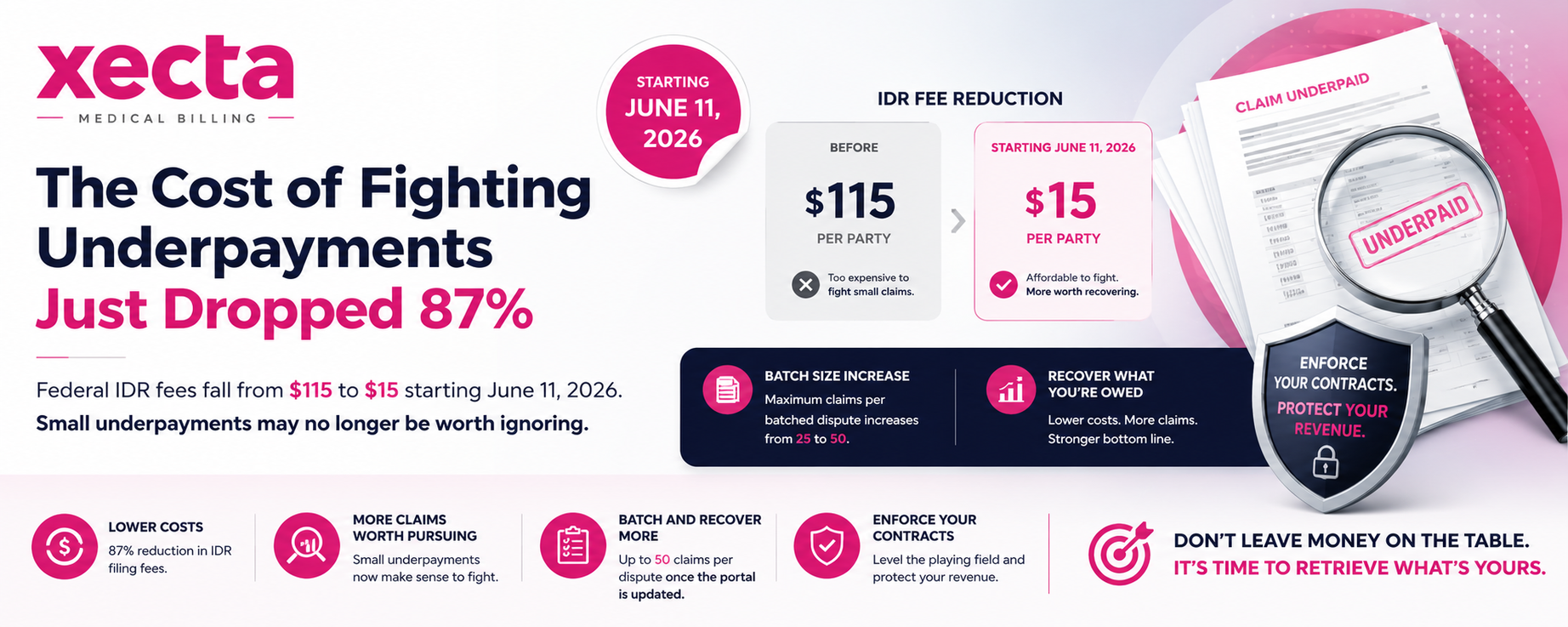
Effective June 11, 2026, the federal IDR administrative fee drops from $115 to $15 per party per dispute — an 87% reduction under CMS final rule CMS-9897-F. The rule also expands claim batching from 25 to 50 per filing, introduces a mandatory payer registry, requires CARC/RARC codes on all OON remittance, and standardizes open negotiation timelines. For ASCs, IRFs, LTACHs, and independent practices, this changes the economics of underpayment recovery for every out-of-network claim that was previously written off as too small to dispute.
On May 28, 2026, the Departments of Treasury, Labor, and Health and Human Services published the Federal Independent Dispute Resolution Operations Final Rule (CMS-9897-F) — the most significant operational update to the No Surprises Act's dispute resolution process since it launched in April 2022.
The headline change is the fee reduction. But the rule makes four additional changes that affect how disputes are initiated, how payers must document payments, and how long the resolution process takes. Together, these changes reshape the economics of out-of-network underpayment recovery for every provider type operating with commercial payers.
This article covers all five changes, who they affect most, the practical steps providers should take now, and the compliance timeline for provisions still rolling out through summer 2026.
1. What Is the IDR Process — and Why Did the Old Fee Structure Matter?
The federal Independent Dispute Resolution process was established under the No Surprises Act, which took effect January 1, 2022. It gives healthcare providers a mechanism to challenge out-of-network payment decisions from commercial payers when they believe a claim has been underpaid relative to applicable law or contract terms.
The process works through binding arbitration: the provider and payer each submit their payment offers to a certified IDR entity, which selects one of the two amounts as the final determination. Since the process launched, more than five million disputes have been filed — far exceeding original CMS projections.
The problem was always the cost-to-recovery calculation on small disputes. At $115 per party per filing, challenging a $400 underpayment, a $650 claim variance, or a $900 shortfall rarely made financial sense. Many providers — particularly independent physicians, small ASCs, and community health centers — absorbed those losses rather than pursue them through a process that was cost-prohibitive for low-dollar claims.
⚠ Why Payers Benefited from the Old Fee
Payers understood the economics of the $115 barrier. A provider facing hundreds of small underpayments — each requiring a $115 filing to dispute — faced a straightforward calculation: the cost of challenging them often approached or exceeded the amount recoverable. Countless legitimate underpayments were written off as a result. The June 11 change eliminates that dynamic.
2. Five Key Changes in CMS-9897-F — Effective June 11, 2026
The fee reduction is the most immediately impactful provision, but the final rule makes four additional changes that affect how disputes are initiated, documented, and resolved. The table below summarizes all five — with detailed breakdowns following.
| # | Change | Before CMS-9897-F | After June 11, 2026 |
|---|---|---|---|
| 1 | Administrative Fee | $115 per party per dispute | $15 per party per dispute |
| 2 | Claim Batching Limit | Maximum 25 claims per batched filing | Maximum 50 line items per determination |
| 3 | Payer Identification | No registry — misdirected filings common | Mandatory federal IDR registry with legal entity name and ID number on remittance |
| 4 | OON Remittance Codes | No standardized codes indicating IDR eligibility | CARC and RARC codes required on all OON remittance — providers get earlier dispute eligibility signals |
| 5 | Resolution Timelines | Variable, unpredictable | Standardized: 15-day payer response, 5-day eligibility determination, 30-day payment determination |
Change 1 — Administrative Fee: $115 → $15 Per Party Per Dispute
Effective for all disputes initiated on or after June 11, 2026, the administrative fee paid to the federal Departments drops from $115 to $15 per party per dispute — regardless of the dollar amount in dispute or whether the dispute is ultimately determined to be IDR-eligible. This fee is separate from the certified IDR entity (IDRE) fee, which varies by federal contractor and was not changed by this rule.
The lower fee makes it financially viable to pursue underpayments that would have previously been written off. A provider pursuing a $500 underpayment now spends $15 to open the dispute rather than $115 — a meaningful difference for practices managing tight margins and recurring small-dollar variances across a high-volume payer mix.
Change 2 — Claim Batching Expands to 50 Per Filing
The final rule increases the maximum number of claims allowed in a single batched dispute from 25 to 50 line items per determination. Batching is permitted when claims involve services provided to a single patient on the same or consecutive dates, when claims share the same or comparable billing codes, or when claims fall within eligible specialty categories such as anesthesia, radiology, pathology, or laboratory services.
For practices that see recurring underpayment patterns — the same payer systematically reducing the same procedure codes — batching means those variances can now be consolidated into a single filing rather than addressed one claim at a time. The administrative burden per dollar recovered drops significantly while the recovery potential of each filing increases.
Change 3 — Mandatory Payer Registry
Health plans and insurers must now register in a new federal IDR registry. At the time of initial payment or denial on any out-of-network claim, payers are required to provide the provider with the legal business name of the plan, the plan sponsor's name, and a new registry identification number.
This addresses a long-standing operational problem in the IDR process: disputes being filed against the wrong payer entity, or disputes failing on eligibility grounds because the provider could not correctly identify the responsible plan. The registry creates a standardized identification system that reduces misdirected or ineligible filings before they consume time and filing fees.
Change 4 — CARC and RARC Codes Required on All OON Remittance
Payers are now required to use specific claim adjustment reason codes (CARC) and remittance advice remark codes (RARC) on all remittance sent to out-of-network providers. These codes must indicate whether a claim is subject to the No Surprises Act surprise billing provisions and whether it is eligible for the federal IDR process.
This gives providers a cleaner, earlier signal about dispute eligibility — directly on the explanation of benefits rather than requiring a separate inquiry or follow-up call. For billing teams managing high OON claim volume, structured remittance data makes it significantly easier to identify which underpayments are IDR-eligible and at what stage to initiate open negotiation.
Change 5 — Standardized Open Negotiation and Binding Resolution Timelines
The final rule restructures the open negotiation period — the required 30-day negotiation between the provider and payer before an IDR dispute can be formally initiated — to be conducted entirely through the federal IDR portal using standardized forms. Key timelines are now formalized and binding:
- Payer has 15 business days to respond to an open negotiation notice
- If no agreement is reached, either party can initiate IDR within 4 business days after the negotiation period ends
- The opposing party then has 3 business days to respond with their own notice
- The IDR entity must determine dispute eligibility within 5 business days of selection
- Payment determinations must be issued within 30 business days of the IDR entity being selected
For practices that have historically found the IDR process unpredictable in its duration, these standardized timelines reduce uncertainty about how long pursuing a dispute will take — and give both parties clearer deadlines to manage internally.
3. Who This Change Affects Most
The fee reduction has the most immediate practical impact on provider types that carry high volumes of OON claims with recurring small-to-mid-dollar underpayment variances — and that have historically found the IDR process cost-prohibitive for low-dollar disputes.
Ambulatory Surgery Centers (ASCs)
ASCs frequently operate with narrow payer networks and encounter OON situations across anesthesia, implants, and facility fees. Small per-procedure underpayments across high visit volumes represent meaningful aggregate leakage. At $15 per dispute with batching up to 50 claims, ASCs are now positioned to pursue those variances systematically rather than absorbing them as write-offs.
Inpatient Rehabilitation Facilities (IRFs)
IRFs handle complex cases with extended stays and multi-service billing. Payer underpayments on IRF claims often involve significant per-case dollar amounts alongside procedural disputes — making the IDR process directly relevant and the new economics particularly favorable for facilities that have tracked underpayment patterns but could not economically pursue them individually.
Long-Term Acute Care Hospitals (LTACHs)
LTACHs face ongoing reimbursement pressure from commercial payers on high-acuity, high-cost cases. Many have historically absorbed OON variances because the cost of disputing them did not justify the administrative overhead. The combination of lower filing fees and expanded batching changes that calculation — particularly for facilities with recurring patterns across the same payer and the same procedure codes.
Independent Physicians and Small Group Practices
Small practices were among the most directly harmed by the old $115 fee. For a solo or small-group provider, a filing fee that approached or exceeded the recovery value on smaller claims created a straightforward disincentive. The $15 threshold changes that calculation for any practice with recurring OON underpayments — including those that have never previously used the IDR process.
4. What Providers Should Do Now — Step by Step
The rule change creates a practical window to revisit underpayments that were previously written off as unviable to pursue. A structured approach makes that review more efficient and positions your practice to benefit most from the new economics.
- Audit OON accounts receivable going back 12–18 months. Look specifically for claims below $1,500 that were underpaid or partially denied by commercial payers and never appealed. At the old $115 fee, many of these were written off. At $15, many are now worth pursuing — provided they fall within applicable IDR filing windows.
- Identify patterns across payers, codes, and service lines — not just individual claims. The value of expanded batching is in aggregating recurring variances. A pattern of 30 or 40 claims from the same payer underpaying the same CPT codes warrants a single batched filing rather than individual disputes.
- Cross-reference your remittance for CARC and RARC codes. As payers comply with the new remittance code requirement, your EOBs will carry more specific information about NSA eligibility. Train billing staff to recognize which codes indicate IDR-eligible disputes versus standard appeals.
- Verify payer identity through the federal IDR registry. Once the registry is operational, confirm the legal entity and registry ID on any OON claim before initiating open negotiation. Misdirected filings have historically been one of the leading causes of ineligible IDR determinations — the registry is designed to prevent this.
- Manage the open negotiation period through the standardized portal. Document all portal communications, payer response timelines, and payer positions during the 30-day negotiation window. These records support your IDR submission if open negotiation fails to produce agreement.
- Monitor the federal IDR portal for batching guidance updates. The expanded 50-claim batching provision depends on the updated federal portal being ready to process batches at that volume. Check CMS portal announcements before submitting large batched filings to confirm the new limit is operationally active.
5. What to Watch For — Implementation Timeline
The full rule has staggered applicability dates. While the fee reduction is effective June 11, 2026, other provisions have additional implementation timelines extending into summer 2026 and beyond.
| Provision | Effective Date | Status |
|---|---|---|
| Fee reduction ($115 → $15) | June 11, 2026 | Active |
| Standardized open negotiation (portal) | June 11, 2026 | Active |
| Batching expansion to 50 claims | Pending portal update | Monitor CMS Portal |
| Mandatory payer IDR registry | Summer 2026 (sub-regulatory guidance pending) | Pending |
| CARC / RARC remittance code requirements | Staggered — further guidance expected | Pending |
Note: The Departments have indicated that further sub-regulatory guidance will be issued as payer registry and remittance code provisions roll out. Monitor the federal IDR portal and CMS website for operational updates.
6. Old IDR vs. New IDR — Side-by-Side Comparison
The practical difference between the pre-June 11 IDR process and the updated process across every dimension that affects a provider's decision to file.
| Factor | Old IDR Process (Pre–June 11, 2026) | New IDR Process (Post–June 11, 2026) |
|---|---|---|
| Administrative Filing Fee | $115 per party per dispute | $15 per party per dispute |
| Minimum Viable Dispute Amount | Effectively ~$500+ (fee eroded small recovery value) | Much lower threshold — small-dollar claims now viable |
| Claims Per Batched Filing | Up to 25 claims | Up to 50 line items per determination |
| Payer Identification | No registry — misdirected disputes common | Mandatory registry with legal entity name and ID on remit |
| Eligibility Signal on Remittance | No standardized IDR eligibility codes | CARC and RARC codes required — earlier, cleaner signal |
| Open Negotiation Response Window | Variable / unspecified | 15 business days (payer) — standardized through portal |
| Eligibility Determination | Variable — no binding timeline | 5 business days after IDR entity selection |
| Payment Determination | Variable — often months | 30 business days after IDR entity selection |
| Incentive to Appeal Small Underpayments | Low — fee structure discouraged small disputes | High — $15 barrier makes recovery economically rational |
Who should act on this: Any ASC, IRF, LTACH, or independent practice with commercial OON volume and a backlog of underpayments below $1,500 that were previously written off as too small to dispute. Who this does not apply to: Practices billing exclusively under traditional Medicare Parts A and B, or practices with no OON commercial payer volume — the IDR process applies only to commercial payer disputes under the No Surprises Act.
If you need help identifying IDR-eligible underpayments in your accounts receivable, XMB's revenue cycle management team works with practices across specialties to audit OON claims, identify recovery patterns, and build the documentation needed to pursue disputes. Learn more about our denial management and appeals services.
Frequently Asked Questions: IDR Fee Change and CMS-9897-F
Does the $15 fee apply to disputes already in the IDR process? +
Is the $15 filing fee the only cost to initiate an IDR dispute? +
Can providers use IDR for Medicare or Medicaid underpayments? +
What is open negotiation and is it required before filing IDR? +
Does the batching expansion to 50 claims apply immediately after June 11? +
What types of claims are eligible for batched IDR filings? +
How long does the IDR process take from filing to payment determination? +
📋 Compliance Note
All information in this article reflects the CMS-9897-F Federal Independent Dispute Resolution Operations Final Rule, published May 28, 2026. Applicability dates and implementation timelines are subject to additional sub-regulatory guidance from the Departments of Treasury, Labor, and HHS. This article is for informational purposes and does not constitute legal or billing compliance advice. Consult qualified legal counsel for advice specific to your practice and payer contracts.