⚡ Quick Answer
Orthopedic medical billing in 2026 requires selecting from six CPT code categories — arthroscopy (298xx), arthroplasty, fracture care/ORIF, spine surgery (22xxx), injections, and E/M visits. The highest-volume codes (27447, 29881, 27130) are heavily audited by payers. Accurate reimbursement depends on complete operative documentation, correct modifier usage (50, 51, 59), ICD-10 diagnosis alignment, and prior authorization before surgery.
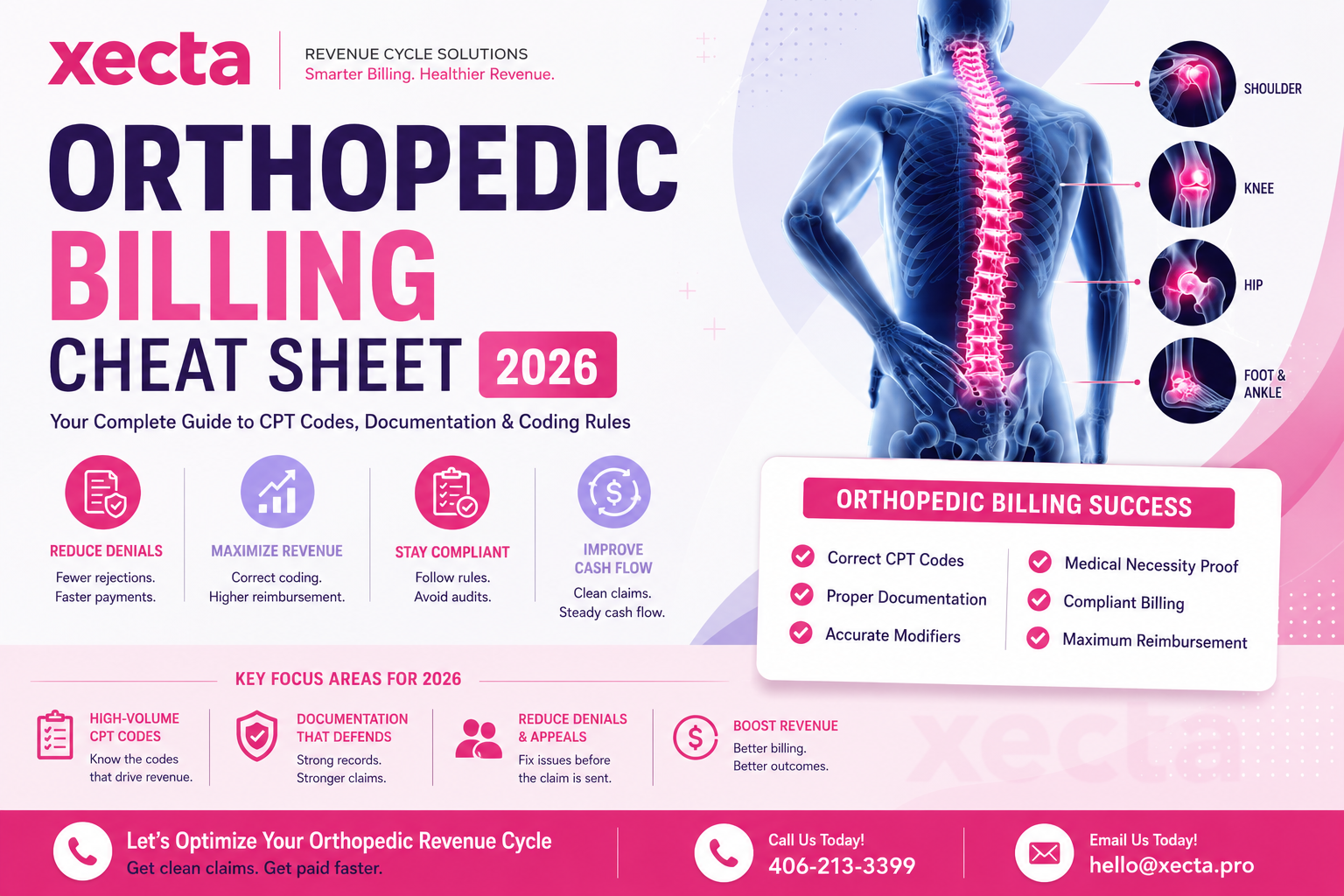
Orthopedic billing is one of the most complex — and highest-risk — specialties in medical revenue cycle management. Procedures range from minimally invasive arthroscopy to total joint replacements and complex spinal fusions, each with strict documentation requirements and intense payer scrutiny.
According to the AAPC, orthopedic coding errors consistently rank among the top five causes of claim denials in surgical specialties. In 2026, updated CPT codes and revised payer edits make it more important than ever for orthopedic practices to stay current and document thoroughly.
This guide covers every layer of orthopedic billing: the CPT code categories, most common procedure codes, documentation requirements, 2026 coding rule updates, and proven strategies to cut denials and accelerate reimbursement.
1. Types of Orthopedic CPT Codes
Orthopedic CPT codes fall into six major procedure categories. Knowing which category a service belongs to is the first step in selecting the right code and applying the correct billing rules.
- Arthroscopy Codes (298xx series) — Minimally invasive procedures of the knee, shoulder, ankle, and other joints. Includes meniscectomy, ACL reconstruction, rotator cuff repair, and diagnostic arthroscopy.
- Joint Replacement / Arthroplasty (27130, 27447) — Total and partial replacement of the hip, knee, shoulder, and other joints. Among the highest-reimbursed and most heavily audited procedures in orthopedics.
- Fracture Care & ORIF (27245 / 27506) — Open reduction internal fixation and related fracture management. Requires highly specific operative documentation to justify the complexity level billed.
- Spine Surgery Codes (22xxx series) — Spinal fusion, decompression, discectomy, laminectomy, and related spine procedures. Code selection is granular — level, approach, and instrumentation all drive the correct code.
- Injections & Pain Management (20610 and others) — Joint injections, trigger point injections, and nerve blocks, commonly performed in orthopedic offices and ASCs.
- E/M Visits (99202–99215) — Office consultations, new and established patient visits, pre-op evaluations, and post-op follow-ups. Must be documented and billed separately from the surgical global period when applicable.
2. Most Common Orthopedic CPT Codes (2026)
The following codes represent the highest-volume, highest-revenue procedures in orthopedic practices. They are also the codes most frequently targeted in payer audits — making accurate documentation non-negotiable.
| CPT Code | Description | Key Billing Note |
|---|---|---|
| 20610 | Joint Injection (large joint) | Document joint, substance used. Site-of-service affects rate (office vs. ASC). |
| 29881 ⚠ | Knee Arthroscopy, Meniscectomy | Specify medial vs. lateral. Cannot unbundle from 29870 when performed together. |
| 29888 ⚠ | ACL Reconstruction | Document graft type. Modifier 51 applies with other arthroscopic procedures same session. |
| 29827 ⚠ | Arthroscopic Rotator Cuff Repair | Number of tendons repaired must be specified. Distinguished from open repair (23412) by approach. |
| 23412 | Open Rotator Cuff Repair | Requires distinct open approach documentation. Not billable with 29827 for same shoulder, same date. |
| 27130 ⚠ | Total Hip Arthroplasty | Prior auth almost always required. Document failed conservative treatment and functional limitation. |
| 27447 ⚠ | Total Knee Arthroplasty | 90-day global period. Modifier 50 for bilateral. Most commonly audited orthopedic surgical code. |
| 27245 / 27506 | Fracture Fixation (ORIF) | Code depends on fracture site, displacement, fixation type. Do not report hardware component codes separately. |
| 63030 ⚠ | Lumbar Discectomy (single level) | Add-on code +63035 for each additional level. Approach and spinal level must be clearly documented. |
⚠ Codes marked with ⚠ are high-volume, high-revenue procedures subject to routine payer audits. Complete operative documentation is required on every claim.
3. Essential Documentation Requirements
Documentation is the backbone of every orthopedic claim. Payers require a clear clinical picture that connects the patient's condition, the treatment decision, and the procedure performed. Missing a single element is a common denial trigger.
Required Documentation Checklist
- Patient history & symptoms — Chief complaint, onset, duration, severity, and functional impact.
- Physical examination findings — Range of motion, strength, joint stability, and relevant positive clinical signs.
- Imaging reports (X-ray, MRI, CT) — Radiological findings supporting the diagnosis and procedure. Must be referenced in the clinical note and operative report.
- Failed conservative treatment — Documentation of prior physical therapy, injections, medications, or bracing — showing less invasive options were attempted first.
- Operative report (all surgical claims) — Must describe the exact approach, intraoperative findings, and all procedures performed in enough detail to support every CPT code billed.
- Medical necessity justification — A clear statement or inferable clinical picture explaining why this specific treatment was medically necessary at this time.
Important: Missing any element above is a potential denial or audit trigger. Never submit surgical claims without a complete, procedure-specific operative report.
4. Orthopedic Coding Rules — 2026 Updates
The 2026 CPT update cycle brought revised codes and modified bundling rules relevant to orthopedic practices. Every biller working orthopedic claims must know the following rules to stay compliant and maximize reimbursement.
Use the Latest CPT 2026 Codes
Annual CPT updates are mandatory. Using deleted codes or outdated descriptors is a billing error that can trigger audits, automatic rejections, and payment reversals. Confirm your charge master and practice management system are loaded with the 2026 CPT edition before submitting any claim.
Apply the Correct Modifiers
Three modifiers drive most orthopedic billing decisions:
- Modifier 50 — Bilateral procedure performed in the same surgical session.
- Modifier 51 — Multiple procedures performed during the same operative encounter.
- Modifier 59 (or X-modifiers) — Distinct procedural service; prevents inappropriate NCCI bundling edits.
Note: Some payers — including certain Medicare contractors — require RT/LT laterality modifiers instead of Modifier 50. Always verify modifier requirements per payer before submission.
Follow Global Surgical Period Rules
Most major orthopedic surgeries carry a 90-day global surgical period. Routine post-operative care within that window is bundled into the original surgical payment and cannot be billed separately. Services unrelated to the original surgery during the global period require Modifier 24 (unrelated E/M) or Modifier 79 (unrelated surgical procedure).
Avoid Unbundling Errors
Do not report component codes when a single comprehensive code covers the complete procedure. Common orthopedic unbundling errors include billing hardware implant codes separately or reporting diagnostic arthroscopy (29870) alongside surgical arthroscopy when both were performed in the same session.
Ensure Site-of-Service Accuracy
Inpatient (IP), outpatient hospital (OP), and office (POS 11) billing carries different reimbursement rates for the same CPT code. Billing the wrong place of service results in overpayment or underpayment — both carry compliance risk. Always confirm the correct POS before submitting.
Track New 2026 Codes (Including 27713)
The 2026 CPT cycle added new and revised orthopedic procedure codes, including updates in the knee and ankle surgery sections. Confirm your billing system is updated before coding any claim that may fall under a new or revised code range.
5. How to Bill Orthopedic Procedures Correctly: Step-by-Step
A structured billing workflow is the most reliable way to minimize errors, prevent denials, and ensure every orthopedic claim is submitted with maximum supportable charges.
- Verify insurance eligibility and prior authorization — Before the procedure date, confirm active coverage and obtain prior authorization for all surgeries that require it. For most major orthopedic procedures, missing prior auth results in a non-appealable denial.
- Select the correct CPT code from the 2026 book — Use the current codebook. Select the code that precisely describes what was performed. In orthopedics, small variations in technique (open vs. arthroscopic, partial vs. total) map to different codes with significantly different reimbursement rates.
- Align ICD-10-CM diagnosis codes with medical necessity — Every CPT code must be supported by a diagnosis code that justifies the procedure. Use the most specific ICD-10 code available — laterality, stage, and encounter type all matter.
- Apply correct modifiers — Apply Modifier 50 for bilateral, Modifier 51 for multiple procedures, and Modifier 59 for distinct services that payers would otherwise bundle. Know your global period rules before billing any post-op visit.
- Review the operative report before submission — Every CPT code on the claim must have a corresponding narrative in the operative report. Review it before submission — not after a denial. Look for procedure descriptions, laterality, surgical approach, and implant documentation.
- Submit the clean claim and monitor remittances — Submit electronically and monitor remittance advice for remark codes and denial patterns. Conduct monthly internal audits on your top-volume CPT codes to catch patterns before they become costly RAC review targets.
6. Pro Tips to Reduce Orthopedic Billing Denials
Denials in orthopedic billing follow predictable patterns. Here are the six most impactful changes your practice can make to reduce them.
1. Build Prior Authorization Into Scheduling — Not Billing
Authorization must be obtained before the patient enters the OR, not after the claim is denied. Make pre-certification a joint responsibility of scheduling and front-desk staff, with the authorization number documented in the chart before the procedure date.
2. Run a CPT + ICD-10 Alignment Check on Every Claim
Mismatched code pairs — a knee arthroscopy billed against a hip diagnosis, for example — are auto-denied by payer edits before a human ever reviews the claim. A 60-second alignment review before submission prevents it entirely.
3. Update Your Charge Master Every January
Deleted CPT codes trigger automatic rejections. Set a calendar task each January to load 2026 code updates into your practice management system and charge capture tools. One outdated code in your system can generate hundreds of denials before it's caught.
4. Require Detailed Operative Notes from Surgeons
The most preventable orthopedic denial is a brief or templated operative report that cannot support the codes billed. Billing staff cannot fix a documentation gap after submission. Educate your surgical team on exactly what the operative note must contain for each procedure type.
5. Conduct Quarterly Internal Audits on High-Value Codes
Audit your top 10 CPT codes by charge volume every quarter. Review for denial patterns, modifier usage, and documentation completeness. Internal audits are the single most cost-effective denial-prevention strategy available to any orthopedic practice — and they protect you before a payer-initiated audit does the same review with consequences.
6. Appeal Denied Surgical Claims — Every Time
Most payers allow 90–180 days from the remittance date to appeal. High-value orthopedic surgical denials should never be written off. A well-documented appeal with operative notes, clinical records, and a brief medical necessity letter reverses a significant percentage of initial denials. According to HFMA, practices that systematically appeal surgical denials recover 40–60% of initially denied surgical revenue on first-level appeal.
7. In-House Billing vs. Outsourcing Orthopedic Billing
Orthopedic billing is a specialist skill. The decision to keep it in-house or outsource directly impacts collections, compliance posture, and administrative overhead.
| Factor | In-House Team | Outsourced to XMB |
|---|---|---|
| 2026 CPT Updates | Requires annual training investment | Always current — no action needed |
| Modifier Expertise | Often a knowledge gap in generalist billers | CPC/CPB certified specialists |
| Prior Auth Management | Often falls through scheduling cracks | Managed as part of the workflow |
| Claim Denial Rate | Varies widely with team experience | Industry-leading low denial rate |
| Compliance & Audit Readiness | Depends on internal compliance program | CPMA-certified compliance monitoring |
| Cost Structure | Fixed overhead (salary, benefits, training) | Performance-based — scales with volume |
Who this is for: Orthopedic practices with high surgical volume, recurring denial patterns, multiple providers, or no dedicated certified billing staff. Who this is not for: Single-provider practices with very low surgical volume that already have a certified orthopedic billing specialist in-house.
Learn more about our orthopedic billing services or explore our denial management program.