⚡ Quick Answer
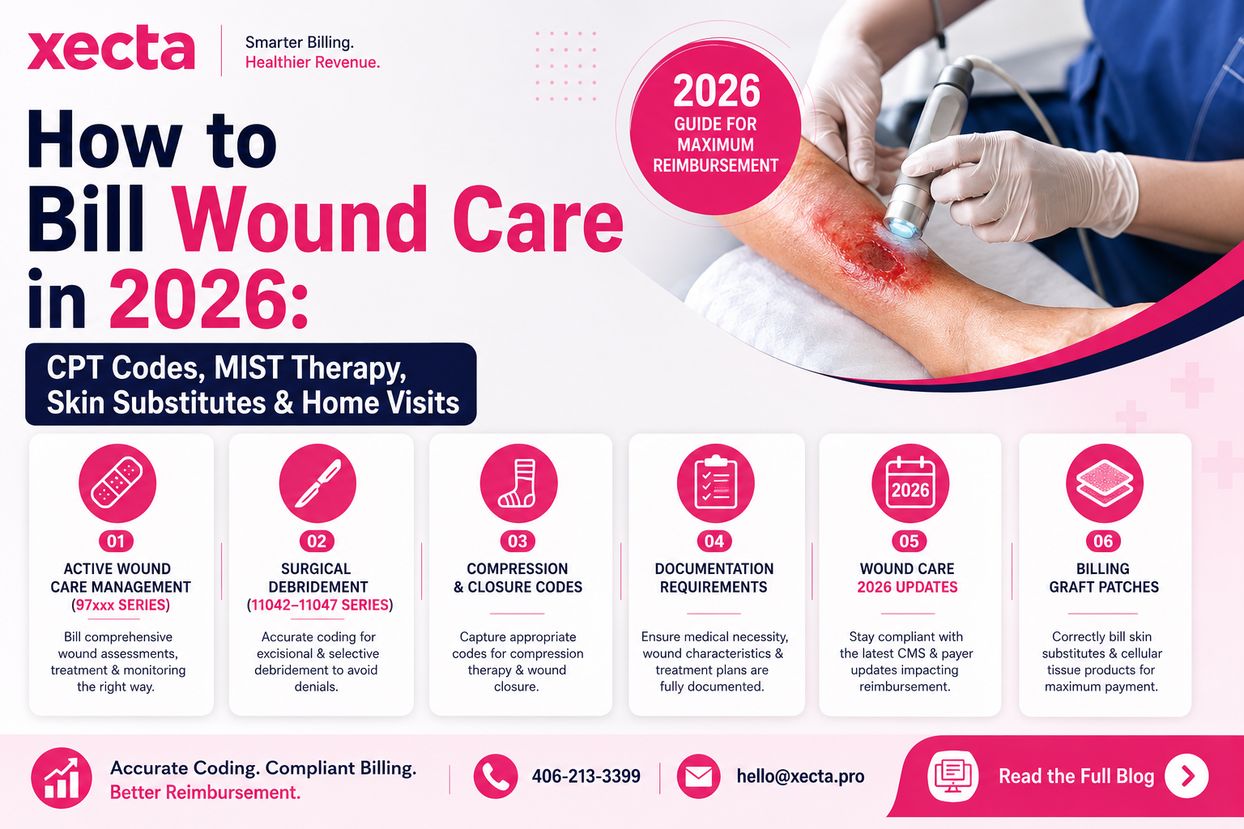
Wound care billing in 2026 requires selecting CPT codes based on tissue depth removed (11042–11047 for surgical debridement), surface area and technique (97597–97602 for active wound care), or procedure type (97610 for MIST, 97605–97608 for NPWT). The biggest 2026 change: CMS replaced product-specific skin substitute reimbursement with a flat rate of $127.14 per square centimeter under Q41xx HCPCS codes paired with CPT 15271–15278. Only 18 products are now explicitly covered under updated LCDs. Complete wound measurements, dual ICD-10 coding for diabetic ulcers, and 30-day conservative care documentation are mandatory for payment.
Wound care billing carries one of the highest denial rates in all of outpatient medicine — between 25% and 35% per visit, compared to approximately 12% in general medicine. The gap exists for a specific reason: wound care CPT code selection is not based on what the wound looks like, but on what tissue was physically removed, what device was used, and how large the wound area was. A generalist biller who does not know those distinctions will submit the wrong code on every visit without triggering a single denial notice — because underpayment generates no error message.
2026 brought the most significant regulatory change wound care has seen in years. CMS eliminated product-specific skin substitute reimbursement under ASP+6% and replaced it with a flat rate of $127.14 per square centimeter for nearly all cellular and tissue-based products (CTPs) — a shift projected to reduce federal spending by $19.6 billion and that fundamentally changed the economics of graft billing overnight. Simultaneously, OIG scrutiny on wound care claims reached an all-time high, with $185 million in improper skin substitute payments blocked in 2025 alone.
This guide covers every element of compliant wound care billing for 2026 — the CPT codes, documentation requirements, 2026 coding rule updates, graft application billing, modifier rules, home service billing, and a step-by-step claim workflow — with verified references to current CMS policy, MAC billing articles, and the CY 2026 Physician Fee Schedule Final Rule. To see how these errors play out in a real practice, read our wound care billing case study documenting $189,000 in recovered revenue. For a full overview of XMB's wound care billing services, visit our wound care medical billing services page.
1. CPT Codes That Drive the Most Revenue in Wound Care
The AMA CPT 2026 code set organizes wound care procedures into four billing categories. Understanding which category a service falls into — and the rules that govern that category — is the first and most consequential decision in wound care coding. For a full CPT reference specific to your practice setting, see XMB's wound care medical billing services page.
Category 1: Active Wound Care Management (97xxx Series)
These codes are used in outpatient and clinic settings and are the highest-volume codes in most wound care practices. Code selection depends on surface area, technique, and device type — not tissue depth.
| CPT Code | Description | Key Billing Note |
|---|---|---|
| 97597 | Selective debridement — first 20 sq cm | Requires devitalized tissue physically removed by sharp instrument or waterjet. Cannot be billed on same day as 97610 for the same wound. Medicare limits frequency to once per 7 days per wound site without documented clinical change. |
| 97598 ⚠ | Selective debridement — each additional 20 sq cm (add-on) | Add-on to 97597 for every additional 20 sq cm across all wounds treated in the same session. Surface area summed across all wounds. Most commonly omitted add-on code in wound care — produces silent underpayment, not denials. |
| 97602 | Non-selective debridement (wet-to-dry, enzymatic, autolytic) | Used when technique is non-sharp — enzymatic agents, wet-to-dry dressings, autolytic methods. Not separately billable if it is routine maintenance of a chronic wound without skilled intervention. |
| 97605 / 97606 | NPWT — reusable pump (≤50 sq cm / >50 sq cm) | For reusable DME pump only — professional service billed here; pump and supplies go to DMEPOS MAC separately. Document pressure settings (typically 125 mmHg), drainage characteristics, wound dimensions, and clinical justification. |
| 97607 / 97608 | NPWT — disposable single-use device (≤50 sq cm / >50 sq cm) | All-inclusive — service, device, and supplies are bundled into one payment. Home health billing rules for 97607/97608 changed January 2024: nursing/therapy services related to application are no longer separately billable under home health (included in bundled HHA payment). |
| 97610 ⚠ | MIST therapy — low-frequency, non-contact ultrasound | 2026 Bundling Rule: Cannot be billed with 97597, 97598, 97602, 97605, or 97606 for the same wound on the same date. Bill only when it is the sole wound care procedure for that wound that day. NCCI edits catch all violations automatically. Medicare rate: ~$397/session. |
⚠ Codes marked ⚠ are the most frequently miscoded or omitted codes in active wound care management. Both 97598 and 97610 are sources of significant silent underpayment — they produce no denial when missed.
Category 2: Surgical Debridement (11042–11047 Series)
These codes are selected based on the deepest tissue layer actually removed — not the depth of the wound. Billing 11044 (bone) because bone was probed without documented bone fragments excised is one of the top OIG audit targets in the 2025–2026 Work Plan.
| CPT Code | Tissue Removed | Area / Notes |
|---|---|---|
| 11042 | Subcutaneous tissue (fat) | First 20 sq cm. Add-on: +11045 for each additional 20 sq cm. |
| 11043 | Muscle and/or fascia | First 20 sq cm. Add-on: +11046 for each additional 20 sq cm. |
| 11044 | Bone | First 20 sq cm. Add-on: +11047 for each additional 20 sq cm. Documentation must describe bone fragments, cortical bone, or periosteum physically excised — not merely "bone visible" or "bone probed." High OIG scrutiny. |
| +11045 / +11046 / +11047 | Add-on codes (each additional 20 sq cm) | Correspond to 11042, 11043, and 11044 respectively. Frequently omitted in multi-wound sessions — each omitted unit represents $80–$200 in unbilled revenue per visit. |
Category 3: Compression and Closure Codes
- CPT 29580 — Unna Boot: Zinc oxide compression dressing. Separately billable with documentation of venous etiology and clinical indication. CPT 29445 and 29581 received revised descriptors effective January 2026 — verify your charge master reflects updated language.
- CPT 29581 — Multilayer Compression Bandage: Used for venous leg ulcers. Revised descriptor effective January 2026. May not be billed with 97597/97598 for the same extremity on the same date without documented separate and distinct clinical justification.
- E/M Codes 99202–99215: Office visits for new and established wound care patients. Separately billable on the same day as a procedure only with Modifier 25 (significant, separately identifiable E/M). A routine pre-procedure wound check does not qualify — a new infection requiring antibiotic management or a change in plan of care does.
2. Essential Documentation Requirements for Wound Care Claims
Documentation is the foundational defense against every wound care denial, audit, and ADR (Additional Documentation Request) — and wound care is one of the specialties most frequently targeted by MAC ADR campaigns. Every element below must be present in the clinical note before a claim is transmitted.
Mandatory Elements for Every Wound Care Visit Note
- Wound measurements in centimeters (L × W × D): Required for CPT code selection, add-on unit calculation, and skin substitute reimbursement. Descriptive terms ("small," "moderate," "large") are not acceptable. With the 2026 flat-rate skin substitute payment at $127.14 per sq cm, accurate surface area documentation is now directly tied to reimbursement amount — not just medical necessity.
- Wound location with anatomical specificity and laterality: "Left plantar great toe," not "foot wound." Supports correct ICD-10 code assignment and satisfies LCD coverage criteria that require site-specific documentation.
- Tissue types present in the wound bed: Granulation, slough, eschar, necrotic tissue, fibrinous material, and exposed structures (tendon, bone, fascia) must be described. This information drives debridement code selection.
- Tissue removed (for debridement claims): For 11042–11047, document the deepest tissue layer actually removed. For 97597/97598, document tissue type removed by selective technique. The operative note must be specific enough to independently support the billed code.
- Treatment modality and technique: MIST therapy requires treatment duration in minutes, device used, wound dimensions, and clinical rationale. NPWT requires pressure settings (typically 125 mmHg), drainage type and volume, device type (reusable vs. disposable), and wound dimensions.
- Wound bed and periwound condition: Color, odor, exudate type and volume, periwound skin condition, undermining or tunneling measurements in centimeters.
- Medical necessity justification: The clinical reason this treatment modality was selected over alternatives. For advanced therapies (skin substitutes, MIST, NPWT), explicit documentation that standard wound care was attempted and failed is required.
- 30-day conservative care documentation (for advanced therapies): The "Rule of 30" embedded in LCDs (L38904, L35125) requires documented evidence that a wound failed to respond to at least 30 consecutive days of appropriate standard wound care before skin substitutes, CTPs, or NPWT are considered covered. Include baseline wound measurements, treatment attempts, and failure documentation.
- Provider signature with date and credentials: Must be a licensed wound care provider. PTA/MA documentation alone without supervising clinician co-signature is insufficient for Medicare Part B wound care claims.
- Response to treatment and progress assessment: Comparison of current wound measurements against baseline. "Wound improving" without objective comparison is insufficient — state the specific measurement change.
📋 Documentation Tip — Dual ICD-10 Coding for Diabetic Wounds
Medicare requires dual ICD-10 coding for diabetic foot ulcers. In Box 21 of the CMS-1500, list the diabetes-with-ulcer code first (e.g., E11.621 for Type 2 diabetes with right foot ulcer) followed by the site-specific and depth-specific ulcer code from the L97 series (e.g., L97.516 for right foot, bone involvement, no necrosis). Using only the diabetes code without the L97 specificity code is one of the most common wound care medical necessity denial triggers.
3. Wound Care Coding Rules — 2026 Updates
2026 brought several significant coding rule changes for wound care providers. The following rules govern how CPT codes are selected, combined, and submitted under updated CMS policy and revised MAC billing articles, including Noridian Article A58565 (Revision 11, effective January 1, 2026), which is the most comprehensive active MAC billing article currently covering 15+ Western and Mountain states.
Rule 1 — Deepest Tissue Removed Governs Surgical Debridement Code Selection
For CPT 11042–11044, the code is selected based on the deepest tissue layer actually removed — not the depth visible in the wound or the depth to which instruments were introduced. A wound debrided to subcutaneous fat is 11042 regardless of how deep the wound extends anatomically. This rule applies on a per-wound, per-session basis. If multiple wounds are debrided in the same session at different tissue depths, use the highest-level code for the deepest wound and report additional wounds in the appropriate add-on code increments.
Rule 2 — CPT 97610 (MIST) Cannot Be Billed with Other Active Wound Care Codes Same Day, Same Wound
The 2026 CMS bundling rule for CPT 97610 is absolute: it cannot be billed alongside CPT 97597, 97598, 97602, 97605, or 97606 for the same wound on the same date of service. NCCI edits catch this automatically and generate a bundling denial. CPT 97610 is separately billable only when it is the only wound care procedure performed on that wound that day. If a wound receives both debridement and MIST therapy on the same visit, only the debridement is billable for that wound — not both.
Rule 3 — Debridement Frequency Limits and the KX Modifier
Medicare generally limits selective debridement (97597) to once per seven days per wound site. When more frequent debridement is medically necessary, the provider must document exceptional clinical circumstances in the visit note and append Modifier KX to the claim. KX is the provider's attestation that continued care exceeds coverage thresholds but is medically necessary, and that documentation to support this is on file. Claims exceeding frequency limits without KX are automatically rejected. When frequency limits are exceeded and the patient is a Medicare beneficiary who may bear financial liability, an Advance Beneficiary Notice (ABN) must be obtained and Modifier GA appended.
Rule 4 — Debridement Volume Limit Per Session
CMS guidance states that debridement generally should not exceed 30% of the total wound area in a single session without documented clinical justification. Exceeding this threshold without clear documentation raises medical necessity questions and increases audit risk. If the session requires more extensive debridement, the note must explicitly state the clinical rationale for exceeding the guideline — necrotic burden, infection control, or preparation for advanced therapy application.
Rule 5 — Dressing Changes Are Bundled, Not Separately Billable
CMS continues to emphasize that routine wound dressing changes are not separately reimbursable when performed in conjunction with debridement or active wound management services on the same visit. The dressing change is included in the debridement payment. The only separately billable dressings are surgical dressings supplied to the patient for home use, billed under DMEPOS HCPCS codes (A6196–A6259) — and only with a physician Standard Written Order specifying diagnosis and wound description.
Rule 6 — Site-of-Service Affects Reimbursement Rate
The same CPT code reimburses at different rates depending on where the service is provided. Physician office (POS 11), hospital outpatient department (POS 22), and skilled nursing facility (POS 31) all carry different Medicare allowables for wound care codes. Billing the wrong place of service produces overpayment or underpayment — both carry compliance risk. Confirm the correct POS code before every claim submission, particularly for wound care services provided across multiple locations or facility types.
Rule 7 — The Rule of 30 for Advanced Therapy Coverage
Embedded in LCDs L38904 (Noridian) and L35125 (Novitas), the Rule of 30 requires that a wound show no measurable improvement after at least 30 consecutive days of appropriate standard wound care before skin substitutes, CTPs, or NPWT are considered medically necessary and covered by Medicare. The 30-day progress note is the primary audit defense document — it must include baseline wound measurements, all treatment modalities applied during the 30 days, evidence of failure to respond, and a documented clinical decision to escalate care. No documented conservative care trial means no coverage — this is among the most common wound care denial reasons.
4. Billing Graft Patch and Skin Substitute Applications in 2026 — The CMS Flat-Rate Model
Skin substitute (cellular and tissue-based product, or CTP) billing underwent its most fundamental change in years effective January 1, 2026. Understanding the new model is critical to avoiding both underpayment and compliance exposure on every graft claim. XMB's wound care billing services include full Q41xx product-to-code mapping and 2026 MAC covered product verification on every CTP claim.
What Changed: ASP+6% Out, $127.14/sq cm Flat Rate In
Under CMS Final Rule CMS-1832-F, skin substitutes were reclassified from ASP+6% biologicals to "incident-to supplies" reimbursed at a flat rate of $127.14 per square centimeter across all Q41xx HCPCS codes, regardless of product brand, FDA pathway, or acquisition cost. This applies equally to both physician office and hospital outpatient settings in 2026.
Before this change, reimbursement was calculated as ASP+6% — a model that incentivized expensive products because higher-cost grafts generated higher reimbursement. OIG data showed skin substitute spending surged 40-fold between 2019 and 2024 — from $45 million to over $1.8 billion annually. The flat-rate model eliminates that incentive entirely. Products that previously reimbursed at $300–$400/sq cm under ASP+6% now reimburse at the same rate as products costing $20/sq cm to acquire.
⚠ 2026 Product Coverage — Only 18 Explicitly Covered
Under updated 2026 LCDs, only 18 skin substitute products are explicitly listed as "covered," while 158 are classified as "non-covered" and 154 remain at MAC discretion. Audit your product inventory against the current covered product list for your MAC jurisdiction before applying any graft. Billing a non-covered product exposes the practice to automatic denial and retroactive audit.
How to Bill Skin Substitute Applications in 2026
- Application codes: All skin substitute graft applications are billed using CPT 15271–15278 regardless of clinical setting. Code selection within this range depends on wound location (trunk/arms/legs vs. face/scalp/hands/feet) and wound surface area (≤25 sq cm vs. each additional 25 sq cm). CPT 15271 covers the first 25 sq cm on trunk, arms, or legs; CPT 15272 is the add-on for each additional 25 sq cm; CPT 15273/15274 apply to the face, scalp, eyelids, mouth, neck, ears, genitalia, hands, feet, and digits.
- Product codes: The specific CTP used is reported with the appropriate Q41xx HCPCS code paired to the CPT application code. The Q41xx code identifies the product; the CPT 15271–15278 identifies the application. Both must appear on the claim together.
- Units are based on surface area in sq cm: With the flat-rate model at $127.14/sq cm, accurate wound measurement documentation is directly tied to reimbursement amount. A wound measured as 18 sq cm vs. 22 sq cm produces a materially different payment. Document L × W in centimeters at the time of application.
- Prior authorization: Most commercial payers and Medicare Advantage plans require prior authorization for CTPs. Confirm authorization before application — denials for missing prior auth on skin substitutes are among the most difficult to overturn on appeal.
Frequency Limitations and the KX Modifier for Grafts
CTP or advanced graft application that exceeds four times within a 12–16 week treatment period requires documentation of medical necessity and Modifier KX appended to the claim. Missing the KX modifier on repeat graft applications beyond this frequency threshold triggers automatic denial and opens the claim to retroactive audit. If the patient is a Medicare beneficiary facing potential out-of-pocket liability for a non-covered repeat application, obtain a signed ABN and append Modifier GA.
5. Correct Modifier Usage in Wound Care Billing
Modifier selection in wound care is not optional — it is the mechanism by which a claim communicates to the payer that an otherwise-bundled or frequency-exceeding service is separately payable and clinically justified. Incorrect modifier usage is a top denial driver across all active wound care management and surgical debridement codes.
| Modifier | When to Use in Wound Care | Common Error |
|---|---|---|
| 25 | E/M visit is significant and separately identifiable from the wound procedure on the same date. Example: new infection requiring antibiotic management alongside debridement. | Applying Modifier 25 to a routine pre-procedure wound check. A wound check before dressing change does not qualify — the E/M must address a distinct clinical problem. |
| 59 | Distinct procedural service — used when two services on the same claim would otherwise be bundled by NCCI edits but are clinically distinct. Example: debridement and compression applied to different wounds same day. | Using Modifier 59 without clinical documentation supporting that the services were performed on separate wounds or anatomical sites. Modifier 59 without supporting notes does not override NCCI edits. |
| KX | Service exceeds Medicare frequency limits but is medically necessary. Required when debridement exceeds once per 7 days, or when grafts are applied more than 4 times in 12–16 weeks. Attestation that documentation is on file. | Omitting KX on repeat graft applications or high-frequency debridement claims. Automatic denial without KX when frequency thresholds are crossed — and the error cannot be appealed without it. |
| GA | Advance Beneficiary Notice (ABN) is on file. Used when a service may not be covered by Medicare and the patient has been notified they may be financially liable. Required on the same claim line as KX when appropriate. | Failing to obtain the ABN before providing the service. Retroactive ABN collection after denial is not accepted by Medicare. The ABN must be signed before the service is rendered. |
| 58 | Staged or related procedure during a global period. Example: additional debridement during the global period of a prior surgical wound procedure that was planned as part of a staged treatment approach. | Confusing Modifier 58 (staged, planned, related) with Modifier 78 (unplanned, related complication). The distinction drives whether the global period resets. |
| 79 | Unrelated procedure during global period. If a different wound site requires debridement during the global period of a prior procedure, Modifier 79 identifies it as unrelated to the original procedure. | Billing additional wound care during a global period without any modifier — resulting in automatic denial as bundled into the original global payment. |
| Q7, Q8, Q9 | Required on claims for foot care services in diabetic patients. Indicate the qualifying systemic condition and demonstrate that the care is medically necessary rather than routine foot care. | Omitting foot care modifiers on lower extremity wound care in diabetic patients — resulting in non-covered service denials even when the clinical note documents diabetic neuropathy and ulceration. |
6. Billing Wound Care in Home Service Settings
Wound care delivered in the home setting operates under a distinct set of billing rules that differ substantially from clinic and hospital outpatient billing. Understanding which entity bills what — and what has changed since January 2024 — is essential for any practice or agency providing wound care at home.
Home Health Agency (HHA) Wound Care — Medicare Part A
For Medicare beneficiaries receiving care under a home health plan of care, wound care services are included in the HHA's bundled prospective payment. Routine wound dressing changes and wound assessment visits by registered nurses, LPNs, physical therapists, or occupational therapists are covered under the home health episode payment and cannot be billed separately by the agency. Nursing and therapy services related to the application of NPWT devices at home are reported on TOB (Type of Bill) 32X and are no longer separately billable — they are included in the bundled home health payment as of the consolidated billing rules in effect January 2024.
Physician Professional Services at Home — Medicare Part B
Physician professional services are "carved out" from the HHA bundled payment. A physician or qualified NPP can still bill Medicare Part B for services rendered in the patient's home, including surgical debridement (11042–11047) and wound E/M visits, using Place of Service 12 (patient's home). The physician's professional work is separately reimbursable — but the facility component goes to the HHA. Physician bills under POS 12 receive the facility rate (lower than the non-facility office rate) because the practice overhead is considered lower in the home setting.
Disposable NPWT at Home — Billing Rule Change (Effective January 2024)
Under Section 4137 of the Consolidated Appropriations Act, disposable NPWT (CPT 97607/97608) was separated from home health billing. Key rules for home disposable NPWT in 2026:
- Claims for disposable NPWT sent on TOB 34X with CPT codes 97607 or 97608 for dates of service on or after January 1, 2024 are returned to the provider.
- The disposable NPWT device for home Medicare beneficiaries is billed using HCPCS code A9272 (wound suction, disposable, includes dressing, all accessories) — not CPT 97607/97608 — when provided under a home health plan of care.
- Nursing and therapy services related to application are included in the home health bundled payment and not separately billable.
- For patients not under an active HHA plan of care receiving disposable NPWT at home, the physician or clinic may bill CPT 97607/97608 under POS 12 for the professional service.
Home Wound Supplies — DMEPOS Billing
Surgical dressings supplied to patients for home use are billed to the DMEPOS MAC — not the Part B MAC — using HCPCS codes from the A6xxx series. Medicare covers alginates (A6196–A6199), foams (A6206–A6215), hydrocolloids (A6216–A6233), hydrogels (A6234–A6241), collagen dressings (A6021–A6024), transparent films (A6251–A6256), and wound fillers (A6257–A6259) for wounds resulting from surgery or debridement. All dressing orders require a physician Standard Written Order specifying the diagnosis, wound description, and dressing type before the supplier can bill. NPWT pump supplies for reusable DME at home (E2402 pump, A6550 dressing kits, A7000 canisters) are also DMEPOS-billed, not clinician-billed.
Billing the Physician Home Visit When Wound Care Is Performed at Home (CPT 99341–99350)
When a physician or qualified NPP travels to the patient's private residence to perform wound assessment, evaluation, or debridement, those services are billable under the Home or Residence Services E/M code family — CPT 99341–99350 — using Place of Service 12 (patient's home). This is a distinct billing mechanism from the HHA bundled payment and is one of the most underutilized revenue opportunities in mobile and house-call wound care practices.
⚠ Important Distinction — Homebound Status Is NOT Required
Homebound documentation is only required for the Medicare Home Health benefit (Part A HHA services). For physician Part B home visit billing under CPT 99341–99350, Medicare does not require the patient to be homebound. The record must document medical necessity for the home visit in lieu of an office visit — but homebound status is irrelevant. Confusing the two is one of the most common documentation errors in home visit billing that drives unnecessary denials.
Home or Residence E/M Codes — 2026 Reference Table
Effective January 1, 2023, the AMA merged the former domiciliary, rest home, and home services code families into a single unified family. CPT 99343 was deleted. The current active codes are:
| CPT Code | Patient Type | MDM Level Required | Time Threshold |
|---|---|---|---|
| 99341 | New Patient | Straightforward | 15+ minutes |
| 99342 | New Patient | Low complexity | 29+ minutes |
| 99344 | New Patient | Moderate complexity | 45+ minutes |
| 99345 | New Patient | High complexity | 60+ minutes |
| 99347 | Established Patient | Straightforward | 20+ minutes |
| 99348 | Established Patient | Low complexity | 30+ minutes |
| 99349 | Established Patient | Moderate complexity | 40+ minutes |
| 99350 | Established Patient | High complexity | 60+ minutes (~$193 national average, 2026) |
Add-on code: When total time exceeds the 99345/99350 threshold by 15+ minutes, append 99417 (commercial payers) or G0318 (Medicare) for each additional 15-minute increment. An established patient is someone seen by the physician or a clinician of the same specialty in the same group practice within the past three years.
POS 12 — Billing Rules and Reimbursement
- Place of Service 12 must appear in Box 32 of the CMS-1500 for all wound care services performed at the patient's private residence, apartment, temporary lodging, assisted living facility (use POS 13 for ALF — not POS 12), group home, or custodial care facility.
- POS 12 pays at the non-facility rate — a higher practice expense RVU than the facility rate — because CMS classifies the patient's home as a non-facility setting. Despite the clinician doing more logistical work than an office visit, the reimbursement rate reflects higher overhead allowance.
- The physician must be physically present in the patient's home. Audio-visual or telephone encounters do not qualify for POS 12 billing under standard Medicare rules; most payers returned to requiring in-person presence after the COVID-19 public health emergency ended.
- Cannot be billed during an inpatient hospital stay. CMS Recovery Audit Contractor (RAC) Topic 0011 specifically flags 99341–99350 billed when the patient was an inpatient — this is one of the most actively audited home visit compliance issues. The home visit code is automatically invalid for any date of service during a hospital admission.
- Some commercial payers require separate POS 12 credentialing. UnitedHealthcare, for example, requires active credentialing for home visit billing separate from office visit (POS 11) credentialing. A provider credentialed for POS 11 is not automatically approved to bill POS 12. Check credentialing status before submitting the first home wound care claim with each major commercial payer.
Billing Wound Care Procedure + Home Visit E/M on the Same Day — Modifier 25 Rules
When a physician performs both an E/M service and a wound care procedure (such as debridement) during the same home visit, Modifier 25 must be appended to the E/M code. However, the OIG estimates that 35–40% of wound care Modifier 25 claims are insufficiently documented — making this one of the highest-scrutiny modifier applications in the specialty.
The standard is clear but frequently misapplied: Modifier 25 is valid only when the E/M represents a significant, separately identifiable medical evaluation beyond the pre-procedural assessment of the wound being treated. If the only reason the clinician evaluated the patient was to assess the wound before debridement, Modifier 25 does not apply — that assessment is inherent to the procedure and is not separately reimbursable.
| Scenario | Modifier 25? | Reason |
|---|---|---|
| Clinician assesses wound, performs debridement, documents wound dimensions and tissue removed | No | Pre-procedure wound assessment is inherent to debridement — not a separately identifiable E/M |
| New spreading cellulitis identified beyond wound margin, antibiotic therapy initiated or changed, debridement also performed | Yes | Cellulitis management is a distinct clinical problem requiring separate MDM — legitimately qualifies with two-part note |
| Physician reviews new lab results showing uncontrolled A1c, adjusts diabetes medications, then performs wound debridement | Yes | Diabetes management is separately identifiable from wound treatment — must be documented in a distinct section of the note |
| Routine wound check, dressing change, and standard progress assessment before debridement | No | This describes standard pre-procedure assessment — "evaluated wound and performed debridement" will not survive a Modifier 25 audit |
| Wound care visit where clinician also identifies and manages a new comorbidity unrelated to wound (UTI, hypertension change, medication reconciliation) | Yes | Unrelated condition management qualifies — the note must have two clearly distinct sections: one for the new problem, one for the wound procedure |
The clinical note must contain two clearly distinct components when Modifier 25 is used: a separate medical decision-making section addressing the identifiable clinical problem, and the procedure note for the wound care service. A single note that describes "evaluated wound and performed debridement" does not support Modifier 25. The WCA (Wound Care Advisor) guidance recommends reserving Modifier 25 for approximately 10% of wound care visits — not as a routine addition to every home wound care claim.
CPT 97602 in Home Settings — A Specific Rule Change
CPT 97602 (non-selective debridement — wet-to-dry, enzymatic, autolytic) carries Status B (non-payable) in the physician office setting (POS 11) under Medicare — meaning it is not separately reimbursable there. However, CPT 97602 is payable in home (POS 12) and SNF settings when performed by a licensed clinician as a skilled service. This is a frequently overlooked distinction: practices that have given up billing 97602 because it denies in the office may be leaving legitimate revenue uncaptured for the same service performed at the patient's home. Confirm payer-specific coverage for 97602 at POS 12 before submitting, as commercial payer policies on this distinction vary.
7. How to Bill Wound Care Claims: A Step-by-Step Workflow
Wound care claims require more pre-submission preparation than most outpatient specialties. The following workflow reflects compliant 2026 billing practices for outpatient wound care clinics and physician practices.
- Verify insurance eligibility and prior authorization before the visit. Confirm active Medicare, commercial, or Medicaid coverage. For advanced therapies — skin substitutes, CTPs, NPWT — verify prior authorization requirements with each payer before the service is rendered. Missing prior authorization on skin substitute claims results in a denial that is typically non-appealable on coverage grounds.
- Review the clinical note and identify the procedure performed. For debridement, confirm the deepest tissue layer removed (subcutaneous = 11042, muscle/fascia = 11043, bone = 11044). For active wound care, confirm whether the technique was selective (97597), non-selective (97602), NPWT (97605–97608), or MIST ultrasound (97610). Do not code from the procedure title — code from the documented clinical description.
- Calculate wound surface area and determine primary and add-on units. For debridement codes (11042–11047 and 97597/97598), total the debrided surface area across all wounds treated in the session. Apply the primary code for the first 20 sq cm, then add one unit of the corresponding add-on code for each additional 20 sq cm increment. For skin substitute applications, calculate sq cm for the Q41xx HCPCS code and CPT 15271–15278 unit count.
- Assign ICD-10 diagnosis codes with full specificity. Use the most specific available ICD-10 code — site, laterality, etiology, and depth. For diabetic foot ulcers, list E11.621 (or appropriate E10/E11/E13 variant with the .621 suffix for foot) first, followed by the corresponding L97 series code for the specific foot site and depth. Confirm your selected ICD-10 codes appear in your MAC's Group 1 covered code list (e.g., Noridian Article A58565 lists 1,173 covered Group 1 codes).
- Apply correct modifiers. Modifier 25 if a separately identifiable E/M was performed. Modifier 59 if distinct services that would otherwise bundle are being reported. Modifier KX if a frequency limit is exceeded. Modifier GA if an ABN is on file. Foot care modifiers Q7/Q8/Q9 if applicable to diabetic lower extremity wound care.
- Run the claim through a pre-submission scrubber. Verify CPT-ICD-10 alignment (no code pairs that fail LCD-covered code logic), check for NCCI bundling conflicts (especially any 97610 claim pairing), confirm the correct Place of Service code, and verify that add-on codes are appropriately linked to their primary codes on the claim form.
- Submit electronically and monitor remittance for denial patterns. Track denial reasons by CARC (Claim Adjustment Reason Code) and RARC (Remittance Advice Remark Code). Wound care denials cluster around specific patterns: CARC 18 (duplicate claim), CARC 96 (non-covered), CARC 97 (payment included in allowance for another service), and CARC 50 (non-covered because it is a routine service). Each pattern points to a specific correctable root cause in the billing workflow.
8. Pro Tips for Wound Care Billing — Reducing Denials and Recovering Revenue
Wound care billing has a first-pass denial rate of 25–35%. The following practices are the highest-impact interventions available to any wound care practice operating in 2026.
1. Audit Your Charge Master for 2026 CPT and HCPCS Updates Every January
CPT 29445 and 29581 received revised descriptors effective January 2026. Q41xx HCPCS codes replaced product-specific CTP codes. Any charge master that still references old Q codes, deleted CPT descriptors, or pre-2026 skin substitute billing logic is generating compliance risk on every graft claim. Update the charge master before the first claim of the year — not after the first denial batch reveals the problem.
2. Never Omit Add-On Codes — They Produce Silent Underpayment, Not Denials
CPT 97598, 11045, 11046, and 11047 produce no error or denial when omitted. The claim simply pays at the lower primary-code rate. The only way to catch consistent add-on omission is a procedure-level coding audit comparing documented wound measurements against submitted units. In practices with 80–100 wound care visits per week, each missing add-on unit represents $60–$200 per encounter. Annualized across qualifying encounters, this is typically the largest silent revenue gap in wound care billing. See exactly how this played out in a real practice — our $189,000 wound care billing recovery case study documents 312 qualifying encounters where CPT 97598 was never once submitted.
3. Conduct a MAC-Specific LCD Coverage Check for Every Advanced Therapy Claim
Each of the seven Medicare Administrative Contractors publishes its own billing and coding article for wound care. The relevant active articles for 2026 are: A58565 (Noridian JE/JF, Revision 11, January 1, 2026) for Western and Mountain states; A55909 for CGS; A55818 for Palmetto and First Coast; A53001 for Novitas. Each article lists which ICD-10 codes are covered for debridement, NPWT, MIST therapy, and skin substitutes in its jurisdiction. A claim coded correctly under your MAC's article but submitted with an ICD-10 code from another MAC's list will be denied. Verify covered code alignment for every advanced therapy claim before submission.
4. Photograph Wounds and Include Measurements in the Clinical Note — Not Just the Flowsheet
Wound photographs tied to the clinical note date and identifying information provide the strongest audit defense for debridement and advanced therapy claims. Many MAC ADR requests cannot be adequately responded to with text-only documentation when a photograph would immediately demonstrate wound depth, tissue type, and surface area. Make wound photography standard protocol for every patient receiving surgical debridement, MIST therapy, NPWT, or skin substitute application.
5. Restructure Your Formulary Based on the 2026 Flat-Rate Economics
The shift from ASP+6% to $127.14/sq cm means that product acquisition cost now directly determines margin — not the former reimbursement-by-product model. Products that cost more to acquire than $127.14/sq cm to apply are now margin-negative under Medicare. Review your CTP formulary against acquisition costs, confirm each product is on the 2026 MAC-covered product list, and select products based on clinical evidence and cost-efficiency rather than former reimbursement rates.
6. Appeal Every Denied Surgical Debridement and Skin Substitute Claim
Wound care practices that systematically appeal denied claims recover a substantial portion of initially denied revenue on first-level appeal — particularly for debridement claims denied for "insufficient documentation" where the clinical note does support the code billed. Build a standardized appeal template for each common denial type: medical necessity appeals should include the progress notes, wound measurements, and the applicable LCD coverage criteria; coding-related appeals should include the complete operative note with documentation of technique and tissue removed.
9. In-House Wound Care Billing vs. Outsourcing to XMB
Wound care billing is a specialist discipline. The combination of depth-based CPT selection, surface area calculations, MIST therapy bundling rules, 2026 flat-rate skin substitute economics, and MAC-specific LCD requirements is not navigable with general billing training. The decision between in-house and outsourced billing has direct financial and compliance consequences.
| Factor | In-House Generalist Biller | Outsourced to XMB |
|---|---|---|
| CPT Code Selection (11042–11044, 97597–97610) | High error rate — depth and technique distinctions require wound-specific training not available in general billing programs | CPC/CPB-certified wound care specialists — code selection verified against clinical note before every submission |
| Add-On Unit Calculation (97598, 11045–11047) | Commonly omitted — produces silent underpayment with no denial signal | Surface area reviewed on every claim — add-on units applied to every qualifying encounter |
| 2026 Skin Substitute Billing (Q41xx + 15271–15278) | High risk of using old Q codes or incorrect product-to-code mapping after January 2026 restructuring | Updated for 2026 flat-rate model — product-to-code mapping, covered product list, and LCD compliance verified per claim |
| MIST Therapy Bundling Rule (97610) | Frequently billed with debridement on same visit, same wound — NCCI bundling denial on every occurrence | NCCI bundling conflict check performed pre-submission on every 97610 claim |
| MAC-Specific LCD Compliance | Generic billing — often not jurisdiction-specific for ICD-10 covered code verification | Claims verified against the applicable MAC article for each practice location (A58565, A55909, A55818, A53001) |
| KX and GA Modifier Management | Frequency limits often not tracked per patient — KX omissions on exceeding visits, automatic denials | Per-patient frequency tracking with alerts — KX applied proactively, ABN workflow managed |
| OIG Audit Readiness | Depends entirely on internal compliance program — most small practices have none | CPMA-certified compliance review — documentation audited against current OIG wound care risk areas before submission |
| Denial Rate | 25–35% (industry average for generalist wound care billing) | Target: below 5% — specialty-specific pre-submission scrubbing |
| Annual CPT / HCPCS Updates | Requires staff training investment each January — high risk of using deleted or revised codes mid-year | Always current — charge master and coding logic updated before January 1 each year |
Who this is for: Wound care clinics with specialized procedures (MIST, skin substitutes, NPWT), multi-wound patient populations, heavy Medicare payer mix, or in-house billing staff without wound care specialty certification. Who this is not for: Practices performing only simple wound evaluations and dressing changes with a primarily commercial payer population and a certified wound care biller in-house.
Learn more about our wound care billing services, read how XMB corrected MIST therapy miscoding and missing add-on units in our $189,000 wound care revenue recovery case study, explore our denial management program, or use the free Revenue Loss Calculator to estimate what your practice may be losing to the errors described above.
Frequently Asked Questions: Wound Care Billing and Coding (2026)
What is the difference between CPT 97597 and CPT 11042 — and when do I use each? +
How did skin substitute reimbursement change in 2026 and what does it mean for my practice? +
Can I bill CPT 97610 (MIST therapy) and CPT 97597 (debridement) on the same day for the same wound? +
What documentation is required before a skin substitute can be applied and billed? +
What are the most common reasons wound care claims are denied? +
Can I bill an E/M visit on the same day as a debridement procedure? +
How is wound care billed differently when services are provided in the patient's home? +
📋 Compliance Note
This guide reflects CMS Final Rule CMS-1832-F (skin substitute flat-rate model, effective January 1, 2026), the CY 2026 Physician Fee Schedule Final Rule, Noridian MAC Billing Article A58565 (Revision 11, effective January 1, 2026), and AMA CPT 2026. MAC-specific LCD policies vary by jurisdiction — verify coverage requirements for your specific MAC before submitting any wound care claim. This article is for educational purposes and does not constitute legal or compliance advice. Reimbursement rates referenced are approximate 2026 Medicare national allowables and may vary by geographic locality and practice setting.
Related Resources
- Wound Care Medical Billing Services — Xecta Medical Billing
- Case Study: How XMB Recovered $189,000 by Correcting MIST Therapy Miscoding and Missing Add-On Units
- Denial Management & Appeals Services
- Medical Coding Services (CPC-Certified)
- Free Medical Billing Revenue Loss Calculator
- Revenue Cycle Management Overview